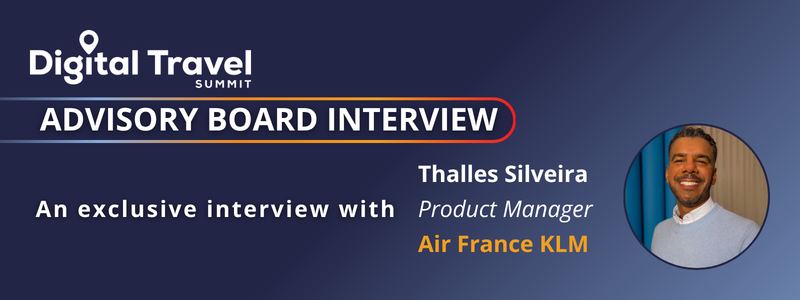
Digital Travel 2026 Advisory Board: An Interview with Thalles Silveira
What do you see as the biggest digital disruption or challenge that travel brands need to prepare for over the next 3–5 years?
For me, the biggest disruption is clearly AI, but not necessarily in the way most people think about it.
What fascinates me is how AI is changing the relationship between brands and customers. Historically, travel companies invested heavily in bringing customers to their websites and apps. Tomorrow, more travel decisions may start with an AI assistant rather than a search engine.
The challenge for travel brands will be remaining visible, relevant, and differentiated when customers increasingly rely on AI to discover and compare options. The companies that succeed will be those that combine strong customer relationships with high-quality data and seamless digital experiences.
How are customer expectations evolving across the travel journey, and what does this mean for digital, marketing, and customer experience teams?
What I observe is that customers no longer compare us only with other airlines or travel brands. They compare us with the best digital experiences they encounter every day, whether that's Netflix, Amazon, or Spotify.
Customers expect simplicity, personalization, and immediate access to information. They want brands to understand who they are and where they are in their journey without having to repeat themselves.
For digital and customer teams, this means we need to stop thinking in channels and start thinking in journeys. The customer doesn't care whether they're interacting through an email, an app notification, or a website. They simply expect a consistent experience.
AI is transforming how travellers discover, book, and engage with brands. Where do you see the greatest opportunities, and risks, for travel businesses?
The opportunity I am most excited about is using AI to make travel feel more personal and less complicated.
Travel can sometimes be stressful. There are many decisions, many touchpoints, and often a lot of uncertainty. AI has the potential to simplify that experience by providing smarter recommendations, more proactive support, and highly relevant communication.
The risk is that we become so focused on automation that we forget the human element. Travel is an emotional business. People travel for holidays, family events, business opportunities, and life moments. If AI creates experiences that feel impersonal or untrustworthy, customers will quickly disengage.
As competition for customer attention intensifies, how can travel brands create more seamless, personalised, and engaging digital experiences?
I think the answer starts with reducing friction.
Many companies focus on adding new features, new campaigns, or new channels. In reality, customers often remember the brands that make things easy.
The most effective personalization is not necessarily the most sophisticated. It's helping customers find what they need faster, anticipating their questions, and removing unnecessary effort from their journey.
For me, great digital experiences are often invisible. Everything simply works the way the customer expects.
With rising acquisition costs and increasing pressure on profitability, what strategies are leading travel brands using to balance growth, loyalty, and long-term customer value?
I believe many travel brands are realizing that acquiring customers is becoming increasingly expensive, while retaining them is becoming increasingly valuable.
The conversation is shifting from "How do we drive the next booking?" to "How do we build a lasting relationship?"
That's where loyalty, personalization, and customer experience become strategic assets rather than marketing tools. The brands that truly understand their customers and consistently deliver value will naturally generate more repeat business and stronger advocacy.
Looking across the industry, what separates the most digitally mature travel organisations from their competitors?
In my experience, the difference is rarely technology.
Most companies have access to similar platforms, tools, and vendors. What really differentiates digital leaders is how they organize themselves.
The most mature organizations empower cross-functional teams, make decisions based on data, and focus relentlessly on customer outcomes. They move faster because they have clear ownership and are willing to challenge traditional ways of working.
Technology is important, but culture and operating model are often the real differentiators.
Register for Digital Travel 2026 to join the conversation with digital innovators from Europe's top travel brands!